


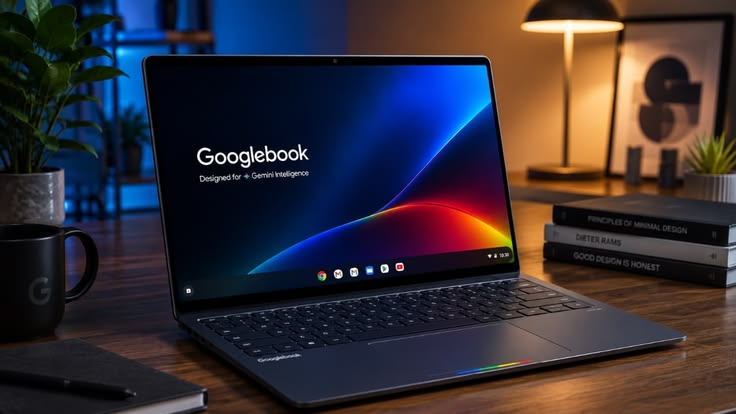

Finally, Google has made a long-standing concept come to life. The initial Googlebook laptops are now up for pre-order, which is the company’s most daring effort to redefine the personal computer using Android instead of approaching it as a different world from the phone in your pocket. Among the first to host these devices were Acer ASUS Dell, HP and Lenovo, each beginning from 899 dollars with arrival scheduled for October 4 in the US, one day later in other countries.
Until now, Chromebooks delivered a very thin and light cloud-first experience that wasn’t ideal in many cases, like when you wanted full Android apps or a full-fledged laptop experience. Googlebook OS is changing the game. Based mostly on the Android stack and a desktop layer taken from ChromeOS, the new system is running Android applications natively and directly without an emulator. This offers a laptop experience where you can mostly just use it like an extension of your Android phone, not a different device that just has the same account in the cloud.
The specifications are a significant upgrade for ambition. All models come with at least 16GB of RAM, a touchscreen reaching 2.8K on the OLED display on most models, and processors from either Intel’s Core Ultra line of chips or a Qualcomm Snapdragon X Elite; the latter also comes with a high-powered neural processing unit for running AI locally. The batteries are said to last up to 14 hours when watching video, or up to 16 hours during web browsing. A sumptuous use of materials lies under the Red Stem of aluminum, magnesium alloy, and possibly carbon fiber that elevates the laptop’s premium aesthetic from many of its eager earlier Chromebooks. A distinctive Glowbar light strip protrudes from the lid, providing a subtle visual indicator that can pulse for notifications or AI activity.
Seamless phone integration is central to the pitch. During setup passwords Wi-Fi details and other preferences pass directly from an Android phone connected via cable or Wi-Fi. Carry over and similar features allow users to start tasks on the phone and then resume them on the laptop. Files and images from the phone are viewable in the laptop’s file manager, and compatible apps can be extended to desktop windows or displayed in cast mode. The vision is of one seamless system, two screens rather than two devices co-existing side-by-side.
Gemini AI is built into the experience. For example, one feature Magic Pointer scans screen visualizations when the mouse position is frozen and offers suggested workflows. Google commits to up to 10 years of system & feature updatesa strength the authors have long identified as a weakness of lower-cost Chromebooks. Every purchase is bundled with a year of Google AI Pro w/ 5 TB of online storageplus short trials for YouTube Premium, Adobe Photoshop, and CapCut.
Pricing, Googlebooks compete head-to-head on price with mid-and high-end Windows computers, (earlier models of the Googlebook, the only convertible in the first batch, were priced at 899 dollars.) and Apple’s Macbook Air (which can retail for up to 1,299 dollars, given the size of the screen).